How to Manage Deliverables Without a Team: Systems That Scale Without Staff
At a glance
Define deliverables, track their status and reuse the parts of your process that recur. Clear next actions and review checkpoints can make solo delivery more consistent without requiring more staff.
1. The Reality of Scaling Solo
Scaling your freelance business doesn’t have to mean hiring a VA, onboarding a project manager, or building a full-blown agency.
In fact, for many freelancers, the goal isn’t managing people at all—it’s managing the work better. Delivering more, faster, with less stress. Taking on bigger clients without burning out.
If you’ve ever thought, “I could take on more work if I wasn’t constantly chasing files, client feedback, or revision rounds,” you don’t need more hands—you need a better system.
You need to run your deliverables like a team would—even if the team is just you.
2. What Happens When You Don’t Have a Deliverable System
Without a system, every deliverable starts to feel like a mini fire drill.
You’re digging through email threads for client files. You’re unsure which version is final. You’re rewriting content because you lost track of feedback. You’re forgetting what you promised—and when.
Eventually, your brain becomes the system. And your brain? It’s over capacity.
When everything lives in your head, your productivity suffers. Your client experience suffers. And the risk of dropped balls or missed deadlines goes up with every new project you book.
You don’t need more hustle. You need a workflow that holds the work for you.
3. What “Systems Without Staff” Actually Look Like
Managing deliverables without a team doesn’t mean doing everything manually. It means setting up tools, templates, and processes that do the heavy lifting.
This could mean:
- A central project hub where all tasks, files, and notes live
- A repeatable process for collecting client info and assets
- Templates for proposals, drafts, and delivery emails
- A shared timeline so you and the client stay aligned
- Tags or statuses that help you sort what’s in progress, what’s blocked, and what’s done
These don’t require employees. They require forethought—and a little discipline.
You’re not building a fortress of rules. You’re building scaffolding to hold the weight of your growing workload.
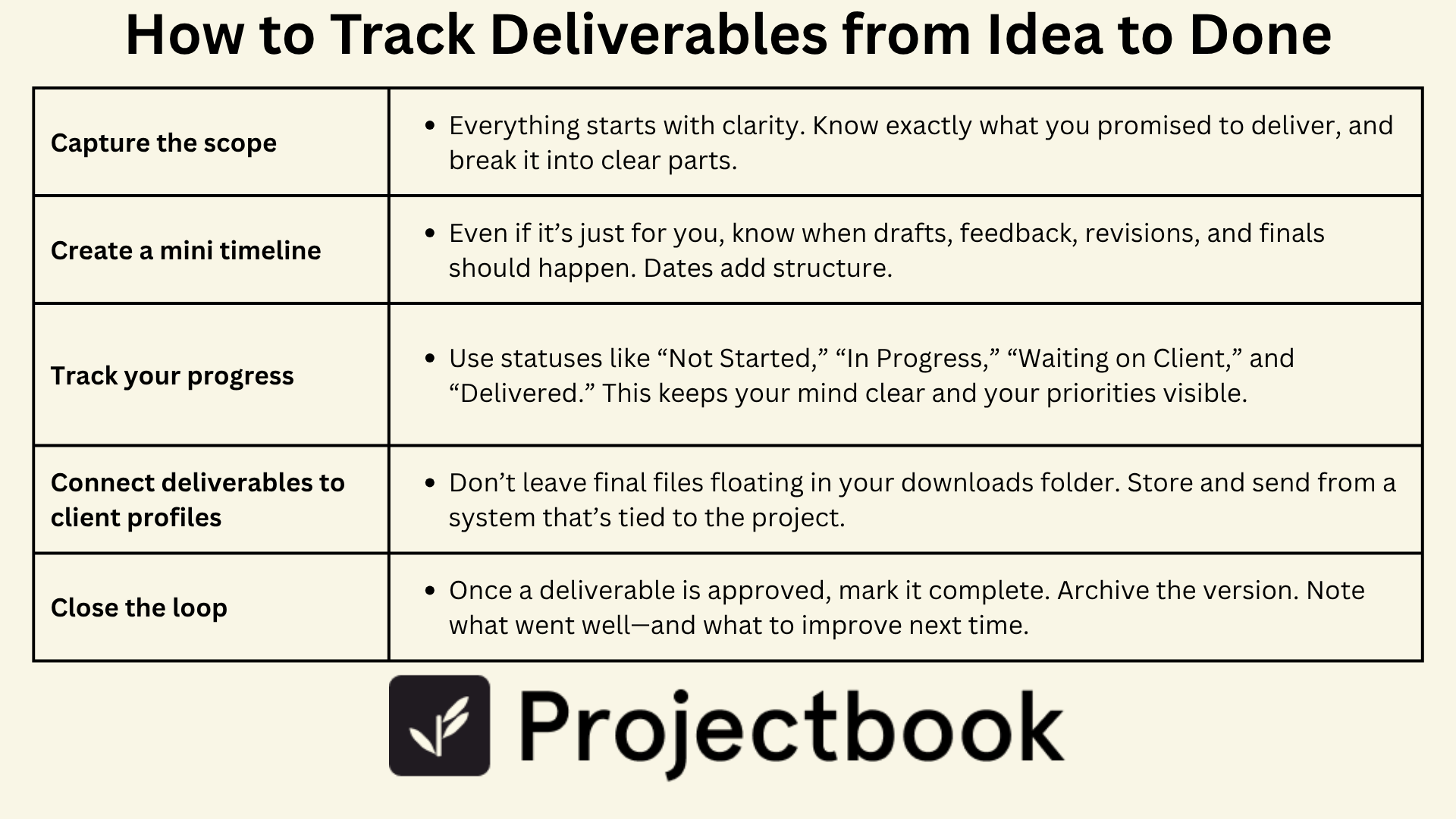
4. How to Track Deliverables from Idea to Done
Here’s a simplified flow that works for most solo freelancers:
- Capture the scope
- Everything starts with clarity. Know exactly what you promised to deliver, and break it into clear parts.
- Create a mini timeline
- Even if it’s just for you, know when drafts, feedback, revisions, and finals should happen. Dates add structure.
- Track your progress
- Use statuses like “Not Started,” “In Progress,” “Waiting on Client,” and “Delivered.” This keeps your mind clear and your priorities visible.
- Connect deliverables to client profiles
- Don’t leave final files floating in your downloads folder. Store and send from a system that’s tied to the project.
- Close the loop
- Once a deliverable is approved, mark it complete. Archive the version. Note what went well—and what to improve next time.
You don’t need a giant dashboard or detailed Gantt chart. You just need a place to see what’s done, what’s next, and what’s still unclear.
5. Client Communication That Doesn’t Require Constant Follow-Up
One of the hardest parts of managing deliverables isn’t the doing—it’s the chasing.
Waiting for feedback. Clarifying requests. Sending yet another “Just checking in on this…” email.
The solution isn’t working longer hours—it’s creating a communication rhythm.
When you have a simple system that:
- Shows the client what’s done and what’s next
- Makes it clear what you need from them
- Sets expectations about timelines and approvals
…you spend less time managing emails and more time delivering great work.
Let your system do some of the talking. It can remind clients where you are in the process and reduce back-and-forth dramatically.
6. How ProjectBook.co Helps You Deliver Without Chaos
At ProjectBook, we designed our platform to help solo freelancers manage client deliverables with the same clarity and consistency a team would bring—without the complexity.
With ProjectBook, you can:
- Track deliverables by project, phase, or client
- Set deadlines, task statuses, and dependencies with ease
- Store drafts, feedback, and finals all in one clean space
- Create reusable templates for common deliverables or workflows
- Stay organized even as your project load grows
Whether you're sending one-off designs or managing multi-phase projects, you always know what’s done, what’s coming, and what’s still in motion.
You don’t need to scale with staff. You can scale with systems that support you.
7. FAQ: Scaling Freelance Deliverables as a Team of One
How do I know when it’s time to systematize?
If you’ve ever dropped the ball on a file, forgotten a deliverable, or felt like every project starts from scratch—it’s time.
Do I need a project manager or VA to grow?
No. You may choose to bring someone on eventually, but strong systems will give you space to grow before you ever need to hire.
What’s the biggest mistake freelancers make with deliverables?
Not tracking them clearly. When things live in email threads and scattered notes, it’s easy to lose track—and lose client trust.
How does ProjectBook help with deliverables specifically?
It lets you organize by project, tag by client, track progress, and store everything in one place—so you’re never guessing what’s due, or where that file went.
Final Word
You don’t need a team to run your business like a professional.
You don’t need to hustle harder to keep up with growing demands.
You just need smart systems that make your work visible, manageable, and repeatable.
Managing client deliverables solo isn’t about doing everything—it’s about knowing where everything is, what’s next, and what’s done.
With ProjectBook.co, you can build those systems—light, calm, and built to scale. No chaos. No dropped balls. Just clear delivery, every time.
From ideas to a clearer week